
Best Privacy Coins 2026: Monero, Zcash and Top Picks Ranked

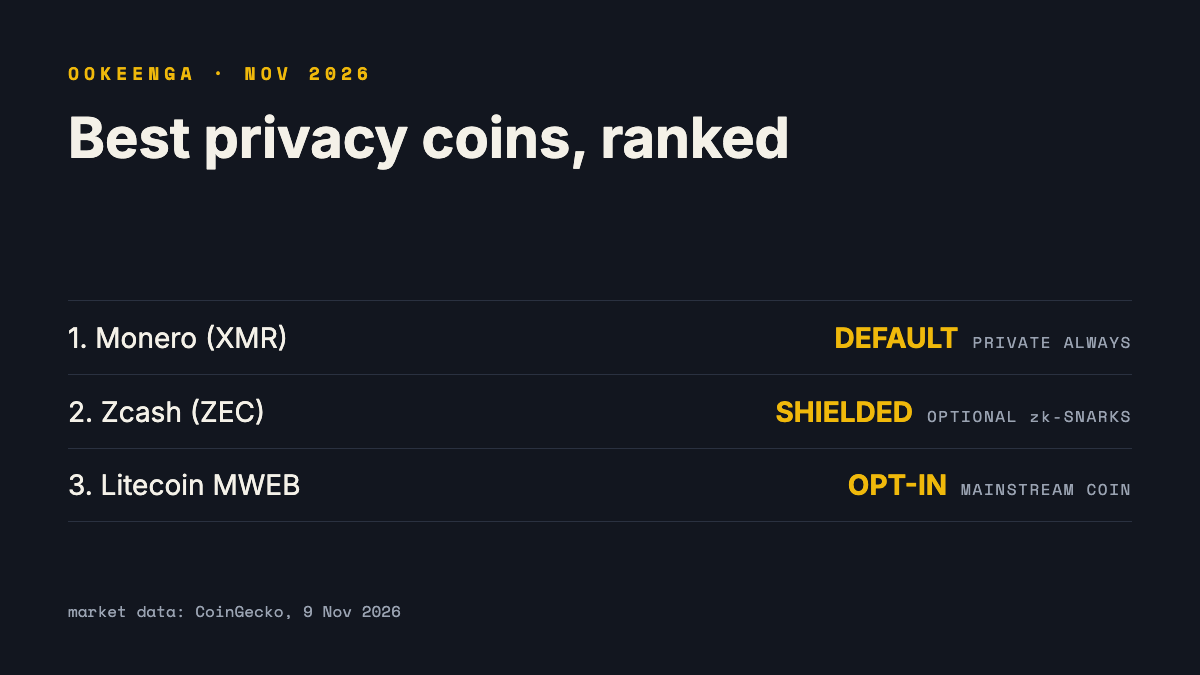
The best privacy coins in November 2026 are Monero (XMR) for privacy by default, Zcash (ZEC) for optional shielded payments with the most liquidity, and Litecoin (LTC) through its MWEB extension for light, opt-in privacy on a widely listed coin. Railgun, Dash, Pirate Chain and Firo fill narrower roles. The ranking below weighs how strong the privacy actually is, how many people use it, and how easy the coin still is to buy as exchanges and regulators tighten rules.
Key takeaways
- Monero is still the strongest privacy coin because every transaction is private by default. It is also the hardest to buy, after years of exchange delistings.
- Zcash is now the largest privacy coin by market cap, about $20.7 billion (rank 10 on CoinGecko). Its privacy only works when you use shielded addresses.
- The EU’s Anti-Money Laundering Regulation stops licensed crypto firms in the EU from handling privacy coins from July 2027. Holding them in your own wallet stays legal.
- Small-cap privacy coins like Firo and Pirate Chain have strong designs but thin liquidity. Price swings and delisting risk are much higher.
Top privacy coins compared by market cap
| Rank | Coin | Privacy model | Market cap (9 Nov 2026) | Best for |
|---|---|---|---|---|
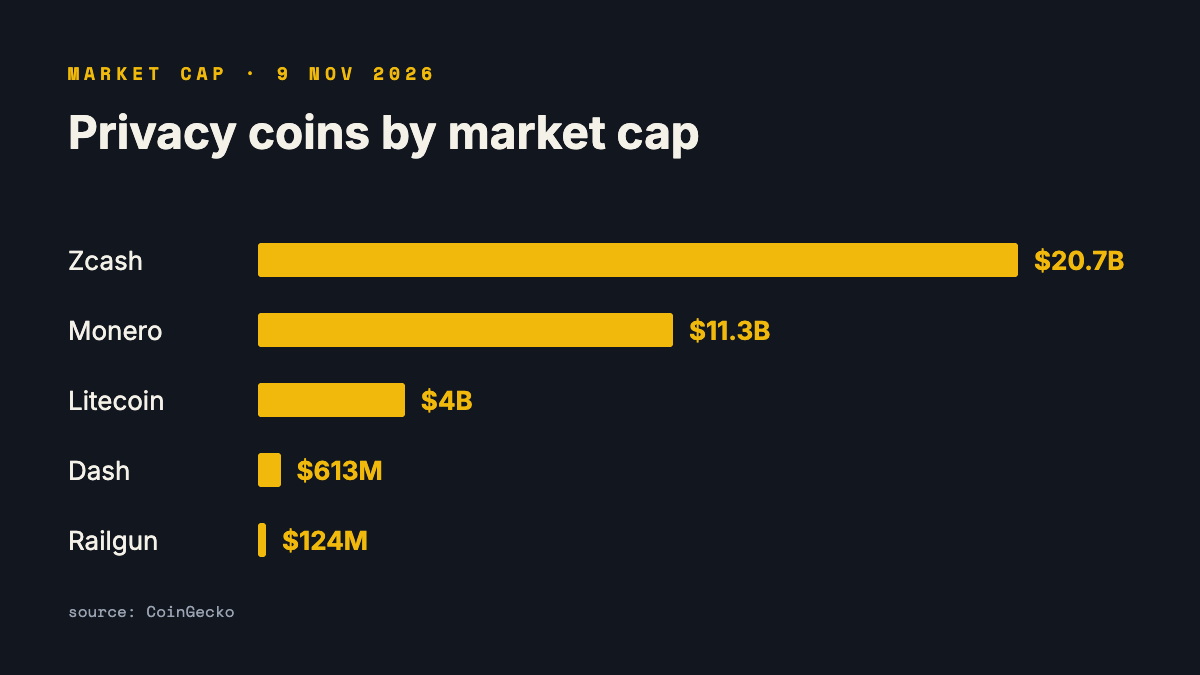
| 1 | Monero (XMR) | Private by default: ring signatures, stealth addresses, RingCT | about $11.3B | Strongest everyday privacy |
| 2 | Zcash (ZEC) | Optional zk-SNARK shielded pool | about $20.7B | Privacy plus liquidity and listings |
| 3 | Litecoin (LTC) | Opt-in MWEB extension blocks | about $4.0B | Light privacy on a mainstream coin |
| 4 | Railgun (RAIL) | zk-SNARK privacy system for Ethereum and EVM chains | about $124M | Private DeFi and token transfers |
| 5 | Dash (DASH) | Optional CoinJoin mixing | about $613M | Fast payments with basic mixing |
| 6 | Pirate Chain (ARRR) | Mandatory zk-SNARK shielded transactions | about $35M | Full shielding, small community |
| 7 | Firo (FIRO) | Lelantus Spark privacy protocol | about $14M | Research-driven privacy design |
How we ranked these privacy coins
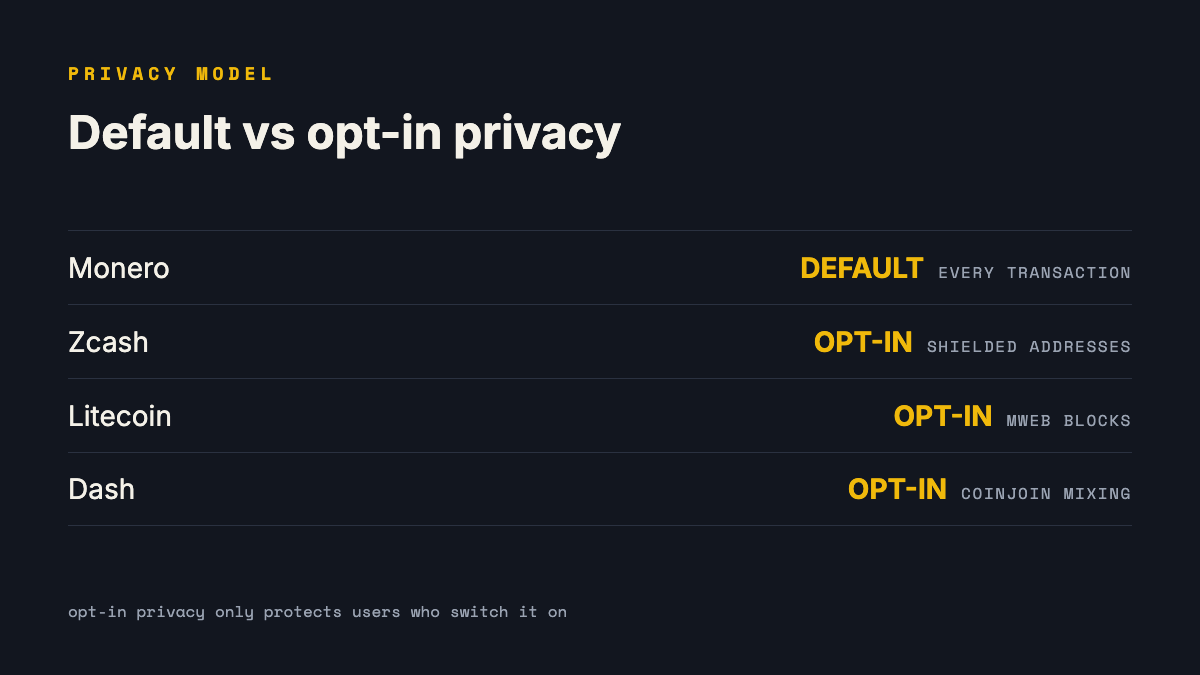
- Privacy strength: is privacy on by default, or does the user have to opt in? Opt-in systems leak more because most people never turn them on.
- Size of the privacy set: how many coins and users share the anonymity pool. A bigger crowd is harder to analyse.
- Liquidity and access: market cap, trading volume and whether major exchanges still list the coin.
- Development: active upgrades, audits and a working team.
- Regulatory exposure: how likely the coin is to lose exchange access in your region.
Market data comes from CoinGecko’s privacy coins category, checked on 9 November 2026. Crypto prices move fast, so treat every figure here as a snapshot, not a forecast.
1. Monero (XMR): the strongest privacy by default
Monero is a proof-of-work cryptocurrency whose blockchain hides the sender, receiver and amount of every transaction. Privacy is not a setting: ring signatures mix your input with decoys, stealth addresses create a one-time address for each payment, and RingCT hides amounts.
- Market cap about $11.3 billion, rank 12 on CoinGecko (9 Nov 2026).
- XMR set its all-time high of about $798 in January 2026.
- The next big upgrade, FCMP++, replaces ring signatures with full-chain membership proofs, so every output on the chain becomes a possible decoy. As of late October 2026 it runs on a public test network and has no official mainnet date. A developer’s working draft points to around March 2027.
Who it is for: anyone who wants private payments without extra steps.
Drawback: access. Binance delisted XMR in 2024, and Kraken stopped offering it in the European Economic Area. In August 2025 the Qubic mining pool also claimed a majority of Monero’s hashrate and caused a six-block chain reorganisation, though analysts disputed the 51% figure.
2. Zcash (ZEC): the largest privacy coin by market cap
Zcash is a cryptocurrency that uses zero-knowledge proofs (zk-SNARKs) to let users send fully encrypted, shielded transactions. Transparent addresses also exist, so Zcash works with exchanges that need to audit flows.
- Market cap about $20.7 billion, rank 10 on CoinGecko (9 Nov 2026). It is the largest coin in the privacy category.
- Network Upgrade 7 (NU7) activated around 5 November 2026. It cut the target block time from 75 to 25 seconds and left the 21 million ZEC supply cap unchanged.
- Ledger hardware wallets now support shielded ZEC on the Nano S Plus, Stax and Flex.
Who it is for: users who want strong privacy and the option to stay compatible with regulated platforms.
Drawback: privacy is optional. Funds sent through transparent addresses can be traced like Bitcoin, so you must use a shielded wallet to get the benefit.
3. Litecoin (LTC) with MWEB: privacy on a mainstream coin
Litecoin is one of the oldest cryptocurrencies, and its MimbleWimble Extension Blocks (MWEB) upgrade adds optional confidential transactions. Coins moved into MWEB hide amounts and addresses, then move back out to regular Litecoin when needed.
- Market cap about $4.0 billion, rank 25 on CoinGecko (9 Nov 2026).
- Research from TNO, the Dutch research institute, found MWEB use grew roughly tenfold from mid-2024, with about 350,000 LTC held in the privacy set.
- Litecoin is listed on almost every major exchange.
Who it is for: users who want some privacy without leaving a liquid, widely accepted coin.
Drawback: MWEB is opt-in and the share of private transactions is small, so the anonymity set is far smaller than Monero’s.
4. Railgun (RAIL): privacy for Ethereum and DeFi
Railgun is a smart-contract privacy system that uses zk-SNARKs to shield tokens on Ethereum and other EVM chains. Instead of a separate blockchain, it lets you hold, send and swap ERC-20 tokens privately.
- Market cap about $124 million (9 Nov 2026).
- Works with existing DeFi apps, so you keep access to Ethereum liquidity.
Who it is for: DeFi users who want private balances and transfers on Ethereum.
Drawback: privacy depends on the smart contracts and on how you move funds in and out. Gas costs and smart-contract risk also apply.
5. Dash (DASH): fast payments with optional mixing
Dash is a payments-focused cryptocurrency with an optional CoinJoin mixing feature that combines several users’ coins to break the link between sender and receiver.
- Market cap about $613 million (9 Nov 2026).
- Masternodes give near-instant transaction locks.
Who it is for: people who mainly want fast, cheap payments and only light privacy.
Drawback: mixing hides links, not amounts, and it is optional. Dash’s privacy is much weaker than Monero’s or shielded Zcash.
6. Pirate Chain (ARRR): mandatory shielding
Pirate Chain is a privacy coin that forces every transaction through zk-SNARK shielded addresses. There is no transparent mode, so no user can leak data by accident.
- Market cap about $35 million (9 Nov 2026), down more than 98% from its 2021 high.
Who it is for: privacy purists who want shielding with no exceptions.
Drawback: a small market and few exchange listings, so it can be hard to buy or sell at a fair price.
7. Firo (FIRO): research-driven privacy
Firo, formerly Zcoin, uses the Lelantus Spark protocol to hide senders, receivers and amounts without a trusted setup.
- Market cap about $14 million (9 Nov 2026).
Who it is for: users who follow privacy research and accept small-cap risk.
Drawback: very thin liquidity. A coin this small can lose most of its value or its listings quickly.
Privacy coins vs Bitcoin and crypto mixers
Bitcoin is not a privacy coin. Every BTC transaction sits on a public blockchain, and analytics firms link addresses to people by following those records. Privacy coins build the protection into the blockchain itself instead of adding it afterwards.
- Bitcoin with CoinJoin: wallets can mix BTC with other users, but the mixed coins are still visible on-chain and some exchanges flag them.
- Ethereum mixers: Tornado Cash was sanctioned by the US Treasury in 2022, and the sanctions were lifted in March 2025. Railgun takes a different route, with a privacy system you hold tokens in rather than a pool you pass through.
- No coin is fully untraceable: mistakes such as reusing addresses, moving funds straight to an exchange with KYC, or leaking your IP address can still link transactions to you.
Are privacy coins legal in 2026?
Owning privacy coins is legal in most countries, including the United States, but access through exchanges keeps shrinking.
- European Union: under the Anti-Money Laundering Regulation (EU) 2024/1624, crypto-asset service providers may not offer or hold anonymity-enhancing coins from July 2027. Coverage of the rule says self-custody and direct wallet-to-wallet transfers stay outside it.
- Japan and South Korea: licensed exchanges are barred from listing privacy coins.
- Exchanges: many centralised platforms have dropped Monero, while Zcash keeps more listings because it supports transparent addresses.
Rules change often. For the latest moves, read our coverage of privacy coins and the regulatory push, and check your local law before buying.
How to choose the right privacy coin
- You want the strongest privacy with no setup: Monero.
- You want privacy but need exchange access: Zcash with a shielded wallet.
- You want a little privacy on a coin you already hold: Litecoin MWEB.
- You live in DeFi on Ethereum: Railgun.
- You only care about fast, cheap payments: Dash.
Whatever you pick, store it in a wallet you control. Our guide to managing a multi-chain crypto portfolio covers wallets and record keeping. If anonymity is your main goal, compare our breakdown of the most secure crypto for anonymity.
Privacy coins are volatile and face delisting risk. Nothing here is financial advice. Only invest what you can afford to lose.
Frequently asked questions
What is the best privacy coin in 2026?
Monero is the best privacy coin for most users in 2026 because privacy is on by default for every transaction. Zcash is the best choice if you also need liquidity and exchange access.
What is the most anonymous cryptocurrency?
Monero is widely seen as the most anonymous cryptocurrency, since it hides sender, receiver and amount on every transaction. Pirate Chain also shields every transaction but has a much smaller user base.
Is Zcash more private than Monero?
Fully shielded Zcash transactions offer very strong privacy, but many ZEC transactions still use transparent addresses. Monero’s default privacy gives every user cover, so in practice Monero is more private.
Will privacy coins be banned in the EU?
From July 2027, EU-licensed exchanges and other crypto-asset service providers may not handle privacy coins. Coverage of the rule says individuals can still hold them in self-custody wallets.
Where can I buy privacy coins?
Zcash and Litecoin trade on most large exchanges. Monero is still available on some platforms such as KuCoin, MEXC and Kraken outside the EEA, and through decentralised swap services. Check availability in your country first.
