
TradingView App Guide: Features, Tips, and How to Maximize Your Trades

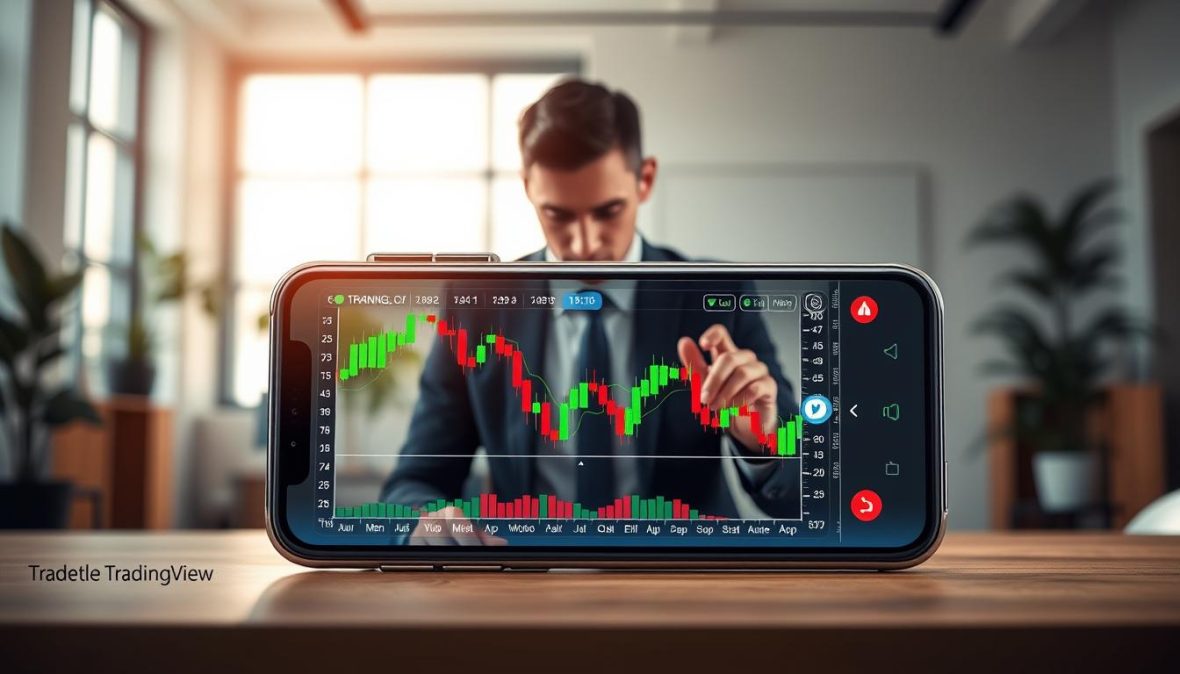
The digital trading landscape has changed dramatically. The TradingView app has become a powerful trading platform. It empowers investors and traders across global markets.
This comprehensive guide unlocks the full potential of mobile trading. It provides strategic insights into chart analysis. You’ll learn advanced trading techniques too.
The TradingView app works for novice and experienced traders alike. It offers an intuitive interface that simplifies complex market data. Traders can navigate real-time charts with ease.
You can conduct technical analysis directly from your mobile device. Making informed decisions becomes simpler. The app puts powerful tools at your fingertips.
Track cryptocurrency, stocks, or forex markets effortlessly. This guide equips you with practical strategies. You’ll maximize your trading performance using TradingView’s robust tools.
Key Takeaways
- Master the comprehensive features of the TradingView mobile trading platform
- Learn advanced chart analysis techniques
- Understand how to customize trading interfaces for optimal performance
- Discover strategies for real-time market monitoring
- Develop skills in technical indicator interpretation
Understanding the TradingView App Interface and Navigation
The TradingView interface gives traders powerful tools for market analysis and visualization. The platform offers intuitive features that make market research and trading decisions easier.
Learning the TradingView app means understanding its core components and customization options. Traders boost efficiency by mastering workspace customization and chart navigation techniques.
Workspace Layout Optimization
Effective workspace customization lets traders create personalized trading environments. The app provides flexible layout options for different trading styles.
Users can arrange multiple charts at once and adjust panel sizes. They can also save custom layouts for various trading strategies.
- Arrange multiple charts simultaneously
- Adjust panel sizes for optimal viewing
- Save custom layouts for different trading strategies
- Create templates across various asset classes
Chart and Watchlist Management
Watchlist management becomes simple with TradingView’s navigation features. Traders can organize their market monitoring efficiently through quick search and custom lists.
- Quick symbol search functionality
- Creating personalized watchlists
- Rapid asset switching
- Organizing favorite markets
| Feature | Functionality | User Benefit |
|---|---|---|
| Multi-Chart View | Display multiple market charts | Comprehensive market analysis |
| Custom Layouts | Save preferred workspace configurations | Faster trading workflow |
| Watchlist Management | Organize and track preferred markets | Streamlined market monitoring |
Mastering these chart navigation techniques creates a more efficient trading environment. Workspace customization helps traders personalize their TradingView app experience.
Essential Charting Tools and Technical Indicators
TradingView offers powerful charting tools and technical indicators for smart trading decisions. The platform gives traders strong analytical capabilities across different financial markets.
Traders can use several types of charting tools to improve their market analysis:
- Drawing tools for precise market visualization
- Advanced technical indicators for trend analysis
- Customizable scripts from the TradingView community
Key TradingView tools include essential drawing tools like:
- Trendlines for tracking price momentum
- Fibonacci retracements for identifying potential support/resistance levels
- Pitchforks for analyzing market channels
- Rectangle tools for defining price ranges
The platform’s technical indicators help traders understand market movements. Popular indicators include moving averages, relative strength index (RSI), and Bollinger Bands. These tools help assess market conditions and identify entry and exit points.
Pro traders recommend using no more than 3-4 indicators simultaneously to prevent chart overcrowding and maintain clear analysis.
Traders can explore the extensive indicator library with built-in and community-created scripts. This flexibility allows for sophisticated market analysis tailored to individual trading styles.
Setting Up Real-Time Price Alerts and Notifications
Traders need a smart way to monitor markets without constant screen watching. TradingView’s price alerts transform how investors track potential trading opportunities. Real-time alerts provide instant market insights, helping traders react quickly to critical price movements.
Effective trading notifications require strategic alert setup. The platform offers powerful tools to customize your market monitoring approach.
Creating Multi-Condition Alert Systems
Advanced traders can use multi-condition alerts to filter out unnecessary noise. These sophisticated trading notifications let you establish complex triggering mechanisms.
- Price crossing specific moving average thresholds
- Relative Strength Index (RSI) reaching predetermined levels
- Volume spike detection
- Combining multiple technical indicators
Managing Alert Frequency and Delivery Methods
Configuring your alerts properly prevents information overload. You’ll never miss critical market signals. TradingView supports various notification channels.
- Mobile push notifications
- Email alerts
- In-app notifications
Pro Tip: Regularly review and update your alert conditions to match evolving market dynamics.
Mastering price alerts transforms your trading strategy. It provides a vigilant assistant that works around the clock. You’ll identify potential opportunities faster.
Analyzing Market Volatility with the TradingView App
Understanding market volatility is crucial for successful trading strategies. The TradingView app provides powerful volatility analysis tools. These tools help traders make informed decisions across different financial markets.
Volatility indicators offer critical insights into price movement patterns. They also reveal potential trading opportunities.
Traders can leverage several key volatility indicators within the TradingView platform:
- Average True Range (ATR) indicator for measuring price volatility
- Bollinger Bands for tracking price volatility and market ranges
- Historical volatility calculators
- VIX index for broader market sentiment assessment
“Volatility is not just about price swings—it’s about understanding market dynamics and potential risk,” says professional trading analyst Michael Roberts.
The ATR indicator stands out as a critical tool for trading volatility analysis. It helps traders determine optimal stop-loss placements and position sizing. This happens by measuring the average price range over specific time periods.
Market volatility increases provide traders with actionable insights. The ATR reveals these insights into potential market movements.
Effective volatility analysis involves understanding different market environments. Traders can use TradingView’s indicators to distinguish between:
- High volatility markets with significant price fluctuations
- Low volatility periods with minimal price movement
- Transitional market states with emerging volatility patterns
Mastering market volatility indicators helps traders develop robust trading strategies. These strategies adapt to changing market conditions.
Advanced Order Book Analysis and Exchange Flow Monitoring
Professional traders use advanced market analysis to understand cryptocurrency trading better. Order book analysis shows market sentiment clearly. It reveals supply and demand patterns that move prices.
The TradingView app gives traders powerful tools for market depth analysis. Order book analysis lets you see beyond price movements. You can examine the market’s inner workings.
Reading Bid-Ask Spreads and Market Depth
Understanding market depth means looking at key indicators:
- Bid-ask spread width reveals market liquidity
- Large order walls can signal potential price resistance
- Tight spreads indicate high trading activity
- Wide spreads suggest potential volatility
Institutional trading patterns show up through exchange flow analysis. Traders track major money movements by watching:
- Net exchange inflows and outflows
- Large volume transactions
- Long-term holder behavior
Tracking Institutional Money Movement
Smart investors use exchange flow data to read market sentiment. Analyzing institutional patterns helps traders build better strategies. These strategies match broader market trends.
Market depth is not just about current prices, but about understanding the underlying market dynamics.
TradingView offers strong tools for order book analysis. These tools give traders an edge in reading complex market movements.
Leveraging Moving Averages and MACD for Trade Timing
Technical analysis traders use moving averages and the MACD indicator to improve their timing. These tools help investors spot market momentum and potential trend changes. They bring precision to trading decisions.
Moving averages smooth out market fluctuations to reveal price trends. Traders rely on two main types. Each offers unique insights into market behavior.
- Simple Moving Average (SMA)
- Exponential Moving Average (EMA)
The EMA strategy weighs recent price action more heavily. This makes it useful for spotting short-term trend changes. Traders study how prices interact with key levels like the 50-day and 100-day EMAs.
The MACD indicator measures momentum through three key parts. It takes technical analysis to the next level. These components work together to reveal market strength.
- MACD Line
- Signal Line
- MACD Histogram
Traders look for specific crossovers and divergences in the MACD indicator. These patterns signal potential trend shifts. A narrowing gap between lines can show weakening momentum.
Understanding these technical indicators transforms raw price data into actionable trading insights.
Combining moving averages and the MACD indicator creates robust trading strategies. Traders can enter and exit positions with greater confidence. This approach improves overall trade timing decisions.
Risk Management Strategies for Leveraged Positions
Leveraged trading can amplify profits, but it also magnifies potential losses. Successful traders know that risk management is the cornerstone of sustainable trading strategies.
Effective risk management in leveraged trading requires a comprehensive approach. This approach protects your capital while maximizing potential returns. Traders must develop a strategic framework that addresses multiple risk factors.
Understanding Health Factors and Liquidation Prices
The health factor is a critical metric in leveraged trading. It represents the risk of liquidation, which can happen rapidly in volatile markets. Traders should closely monitor their health factor to prevent unexpected position closures.
- Track health factor in real-time
- Understand liquidation price thresholds
- Maintain a buffer above minimum health requirements
Setting Stop-Loss Orders to Protect Capital
Stop-loss orders are essential tools for managing risk in position sizing and leveraged trading. These strategic orders automatically close positions when prices reach predetermined levels. This limits potential losses.
- Calculate appropriate stop-loss levels
- Use volatility-based stop-loss strategies
- Implement trailing stop-loss techniques
Professional traders recommend risking no more than 1-2% of total capital on any single trade. By implementing robust stop-loss orders, traders can significantly reduce their risk exposure. Carefully managing position sizes also helps protect capital in volatile markets.
Monitoring Funding Rates and Open Interest Data
Understanding derivatives data is crucial for sophisticated cryptocurrency traders. Funding rates and open interest provide deep insights into market sentiment. These metrics reveal potential price movements in perpetual futures markets.
Funding rates represent periodic payments between long and short position holders. These rates help keep perpetual contract prices aligned with spot market prices. Positive funding rates mean long position traders pay short position traders.
This payment structure indicates bullish market sentiment among traders.
Key metrics to track include:
- Long-short ratio
- Open interest trends
- Funding rate fluctuations
- Derivative contract volumes
Professional traders use advanced tracking tools to monitor these critical indicators. Extremely positive funding rates might signal potential market corrections. Negative rates could indicate trader capitulation.
Open interest represents the total number of outstanding derivative contracts. Declining prices with increasing open interest suggest strategic positioning rather than panic selling. This metric helps traders understand market depth and potential trend reversals.
Successful traders leverage derivatives data to make informed decisions beyond traditional price analysis.
Integrating Stablecoin Metrics and Market Liquidity Indicators
Cryptocurrency traders need sophisticated tools to understand market dynamics beyond simple price charts. Stablecoin metrics and market liquidity indicators provide critical insights into capital movement. These tools help reveal potential market trends.
Stablecoin supply serves as a crucial liquidity indicator in the crypto ecosystem. Traders can leverage key metrics like USDT supply and USDC supply. These metrics help gauge potential market movements.
Understanding Stablecoin Supply Dynamics
Tracking stablecoin metrics reveals important market signals:
- Increasing stablecoin supply suggests potential capital entering the market
- Decreasing supply might indicate investors moving funds outside cryptocurrency
- Stable supply could represent market consolidation
Analyzing Exchange Net Flows
Exchange net flows provide additional context for market liquidity indicators. Monitoring asset movements helps traders understand investor sentiment. This data reveals potential price trends.
| Liquidity Indicator | Market Signal |
|---|---|
| Increasing USDT Supply | Potential Market Entry |
| Decreasing USDC Supply | Possible Capital Withdrawal |
| Net Exchange Outflows | Strong Investor Conviction |
Integrating these crypto market liquidity insights helps traders develop comprehensive market understanding. This approach goes beyond traditional price analysis. Traders gain a clearer view of market movements.
Identifying Support and Resistance Levels for Entry and Exit Points
Mastering support and resistance levels is crucial for successful trading strategies. These key levels represent critical price points where trading momentum often shifts. They provide traders with valuable insights for making informed decisions.
Traders can identify support and resistance zones through several strategic approaches:
- Horizontal support levels from previous price swing lows
- Dynamic resistance zones using moving averages
- Volume profile analysis of trading activity
- Fibonacci retracement price levels
Analyzing cryptocurrencies like Solana requires focusing on specific price levels. For instance, $133.83 represents a critical reclaim level. Meanwhile, $144.10 marks the 100-day exponential moving average (EMA) resistance zone.
Breaking through these key levels signals potential bullish momentum.
“Understanding support and resistance levels transforms random price movements into strategic trading opportunities.” – Professional Trading Analyst
TradingView’s drawing tools enable precise identification of entry and exit points. Traders can mark horizontal support lines and set alerts at resistance zones. This creates systematic approaches for executing trades near critical price levels.
Successful traders recognize that support and resistance levels are dynamic, not fixed. Prices breaking through resistance can transform those levels into new support. This creates opportunities for strategic trade planning.
Conclusion
The TradingView app offers powerful tools for traders. It helps elevate market analysis and trading strategies. By using comprehensive charting tools, advanced indicators, and real-time insights, traders can maximize their success.
Throughout this guide, you’ve learned key tips about the platform’s versatility. From tracking Bitcoin dynamics to understanding Solana’s technical setups, the app provides sophisticated analytical capabilities. These tools transform raw data into actionable trading strategies.
Risk management is critical in any trading approach. The XVS whale event shows why massive liquidations happen. This example underscores the importance of strategic stop-loss orders and monitoring volatility.
Successful traders protect their investment capital. They recognize that safeguarding funds is as crucial as finding market opportunities. Maintaining disciplined capital protection techniques separates winning traders from losing ones.
Mastering the TradingView app requires consistent practice and continuous learning. Start with core indicators and gradually expand your skill set. Always prioritize comprehensive market research before executing any trade.
FAQ
Is the TradingView app free to use?
Can I execute trades directly in TradingView?
What’s the best timeframe for trading?
How many technical indicators should I use?
Are analyst price predictions reliable?
Can I create custom alerts in TradingView?
What is Pine Script in TradingView?
How do I protect my trading capital?
What platforms does TradingView support?
Can I use TradingView for different asset classes?
